There’s a particular kind of miniature collection that works because it isn’t just a pile of separately sculpted models. It’s a world. Every piece answers to the same logic, the same aesthetic, the same underlying story — so that when you set them on the table together, they don’t just look good side by side, they look like they belong together. That’s what we set out to build with the Ironworks of Aurumdell, and it’s about time we told you the story behind it.
This collection started, as most of ours do, with an image: a forge that never stops running, deep underground, powered by something between engineering and obsession. From there, the factions, the characters, and the machinery followed almost naturally. What we ended up with is an industrial fantasy setting with a genuine villain, two very different heroes hunting her, and an army of constructs that range from grimly funny to outright menacing.
If you’ve browsed our Ironworks of Aurumdell collection and wondered what’s actually going on in this world, this is the post for you.
The Setting: A Forge That Was Never Meant to Stop
Aurumdell isn’t a kingdom or a city in the traditional fantasy sense. It’s a complex — furnaces, relay towers, generator blocks, and modular pipework threading through chambers lit only by arcane fire. Nobody lives in Aurumdell so much as they work in it, and the line between industry and something darker gets thinner the deeper you go.
The aesthetic we’re chasing here sits somewhere between steampunk and industrial horror. Rivets and panel lines instead of runes and filigree. Amber boilers instead of glowing gemstones. It’s fantasy built by engineers rather than wizards, which is exactly why resin was the right call for sculpting it — the level of mechanical detail resin can hold, down to individual seams and joint housings, is what sells the illusion that these things were actually built, not conjured.
An Aesthetic With a Purpose
That industrial grounding matters because it changes how the magic in this world reads. Nothing here is elegant. The constructs aren’t summoned, they’re assembled. The transformations aren’t graceful, they’re surgical and a little unsettling. When arcane power shows up in Aurumdell, it shows up as a green-glowing boiler or a soul bound into a chassis, not a shimmering portal. That grounding is what gives the setting its teeth.
Phiera: The Queen of the Forge
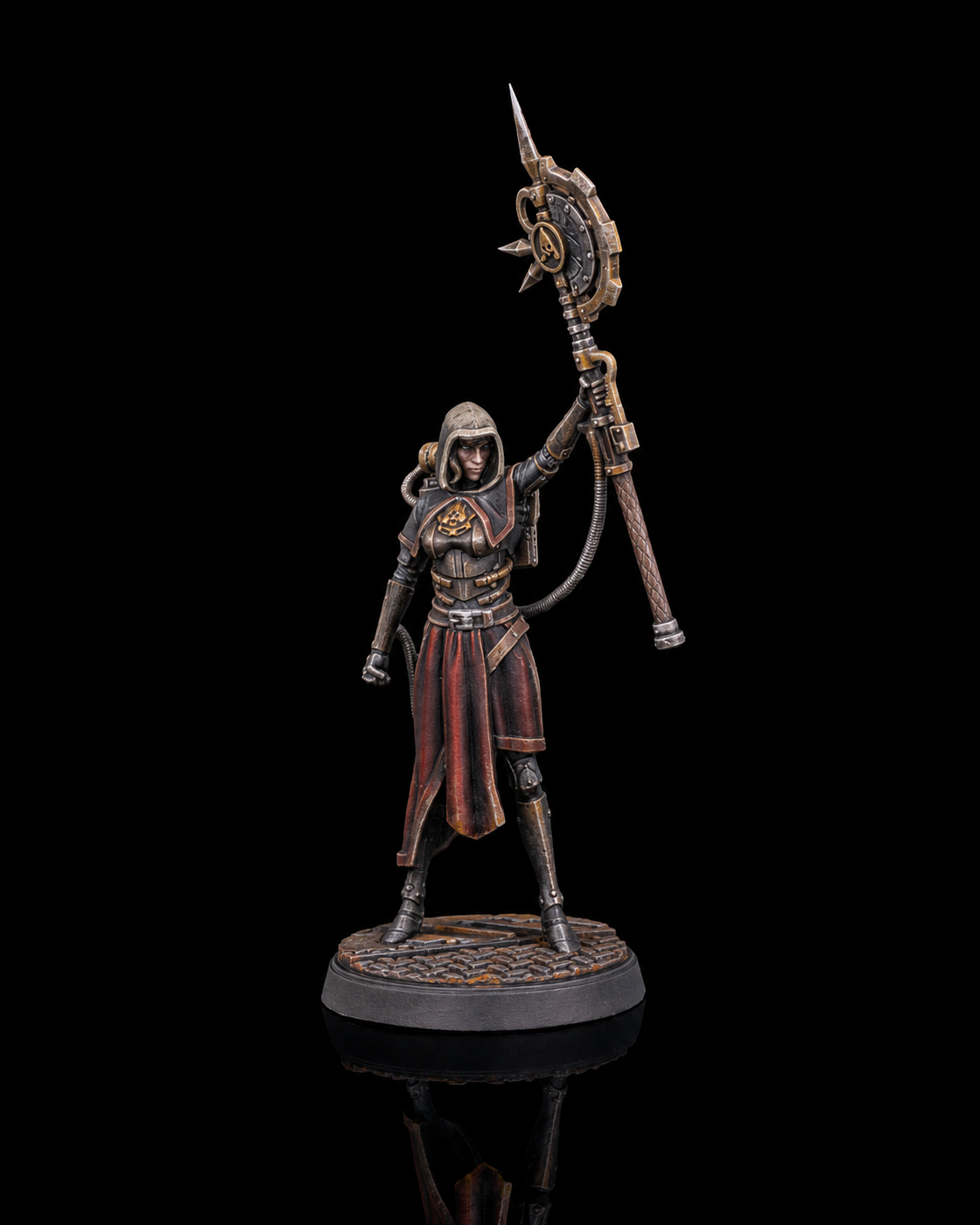
Every good industrial fantasy setting needs someone driving the machine, and in Aurumdell, that’s Phiera. She wasn’t always the Queen of the Forge. She was, once, a gifted elven artificer working within the bounds of accepted practice — until she walked away from tradition entirely and into the forbidden engineering that now defines her.
The transformation shows. One arm iron, one arm flesh. A spiked arcane stave carried less like a tool and more like a declaration. She’s remade herself the same way she remakes everything else in her domain: with purpose, without much concern for what she has to sacrifice to get there. The forge doesn’t sleep because she doesn’t let it.
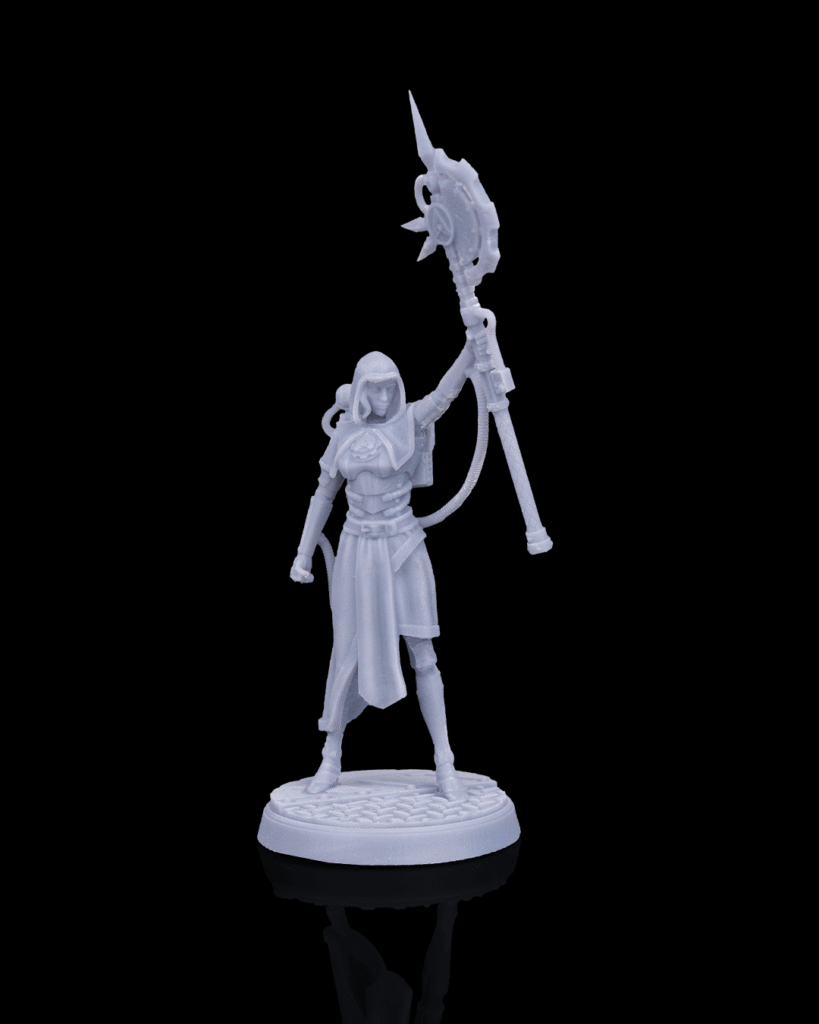
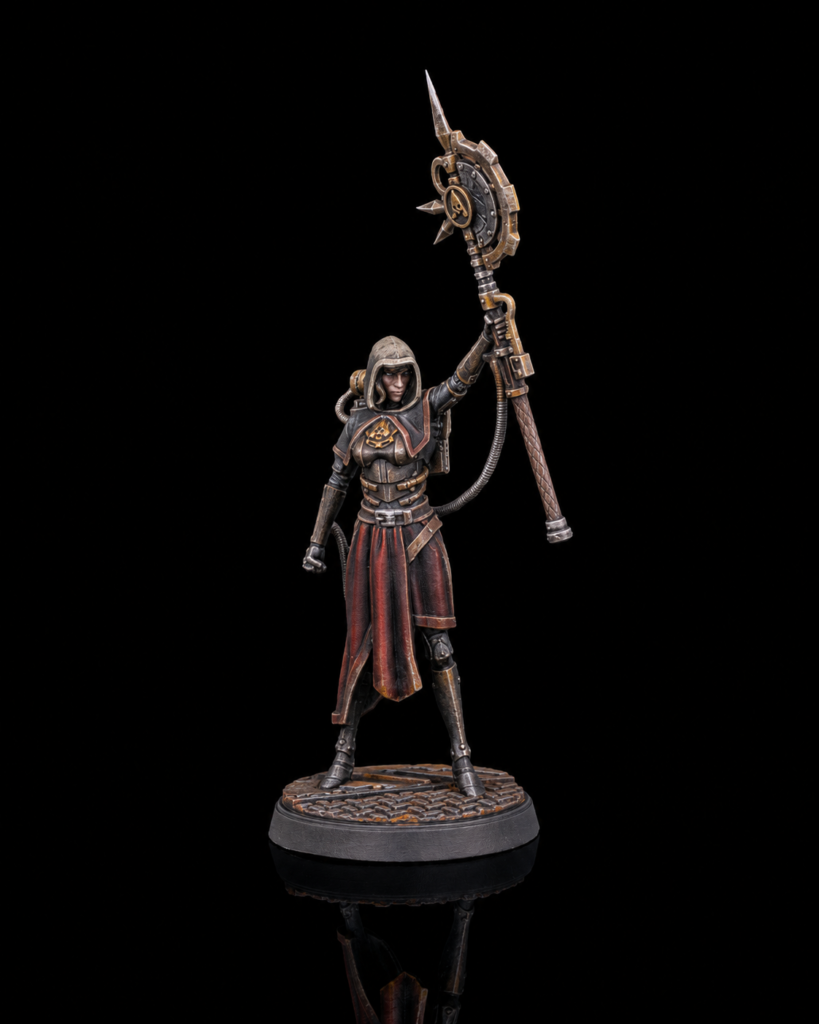
What makes Phiera work as a villain for the tabletop isn’t raw menace, it’s ambition with a coherent internal logic. She’s not building an army to conquer — she’s building because building is what she does, and the scale of what she’s building has simply outgrown any reasonable definition of restraint. That’s a villain your players can understand even as they’re fighting their way through her constructs.
The Army She Built
This is the part of the collection most people ask about first, and for good reason — it’s where the industrial fantasy concept really gets to show off.
The Drones: Welder, Cutter, and Driller
Start with the drones. Welder, Cutter, and Driller began life as worker units — practical, purpose-built, unremarkable. They still carry that worker-drone DNA in their design: functional chassis, task-specific tooling, nothing wasted on ornamentation. But there’s a dark comic streak running through them too, a sense that something in their original engineering never quite worked as intended.
All three drones share a creator, and that shared origin becomes a genuinely useful thread if you’re running them as a set on the table. They read as siblings — not identical, but built from the same hand, with the same slightly-off sensibility underneath the practical exterior. If you’re looking for an easy entry point into the collection, the drone trio is where most people start.
The Golden Strider Golem
Where the drones are workers, the Golden Strider Golem is something else entirely. This is a soul-animated construct — not a machine given purpose by clever engineering, but a body given purpose by something that used to be a person. That distinction matters a lot in Aurumdell’s internal logic. The drones are built. The Golden Strider Golem was made.
On the table, it plays as elite heavy infantry: towering, deliberate, and unsettling in a way that has nothing to do with size. It’s one of the pieces we get asked about most in terms of painting technique, and for good reason — the surface detail rewards careful metallic work and object-source lighting around the areas where the soul-binding shows through.
The Carcinowalker
And then there’s the Carcinowalker, the collection’s centrepiece for a reason. This is Phiera’s personal mount: a massive crab-construct, indestructible by design, built to carry a queen who does not walk when she can be carried. It’s the largest model in the range, and it’s meant to be — everything about its proportions and its stance is built to communicate “boss encounter” the moment it hits the table.
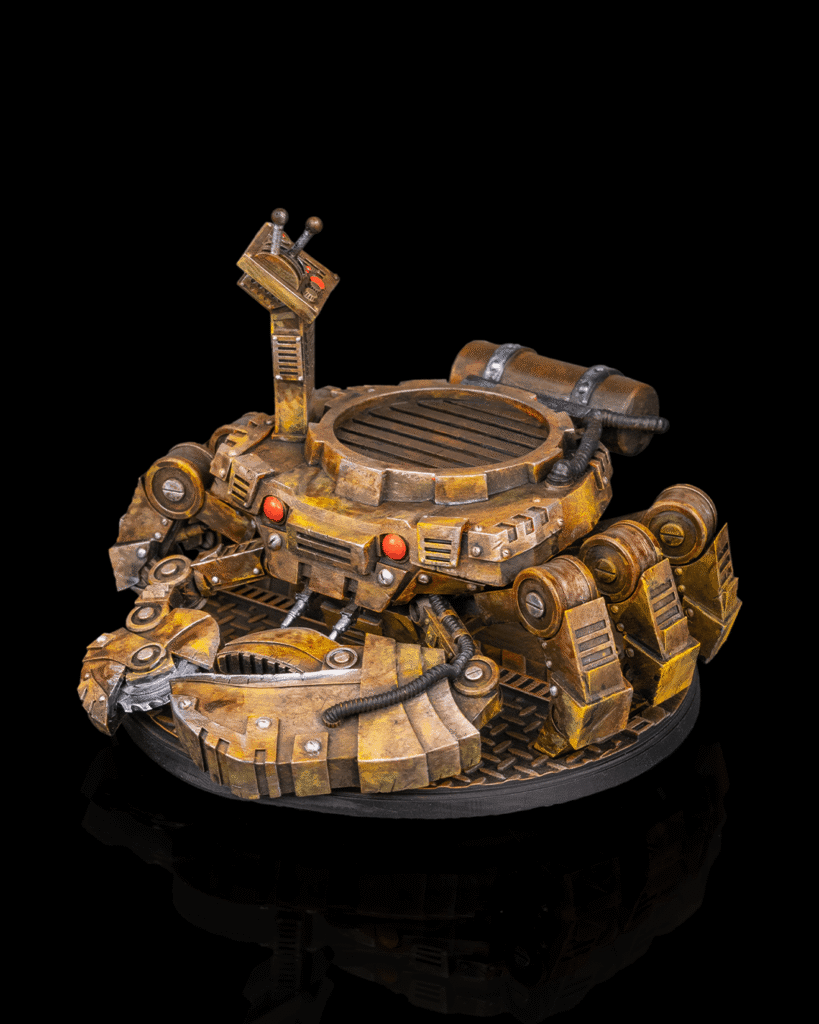
The Carcinowalker also does something the rest of the collection doesn’t quite manage on its own: it makes Phiera’s ambition tangible. A queen who can build something like this isn’t a minor threat, and the model earns that reputation through sheer mechanical presence. If your table needs a final encounter for an Aurumdell-themed campaign arc, the Carcinowalker is built for exactly that job.
Rounding Out the Ranks
The rest of Phiera’s forces fill out the world without stealing focus from the three centrepieces above. The Steam Rhinodrome — amber boiler, single green eye, built like it could go through a wall without noticing — plays as a heavier shock unit. The Murder Barrel is exactly what the name suggests, and its origin as an engineering joke that stopped being funny somewhere along the way is a nice piece of dark humour running underneath the rest of the collection’s more serious tone.
Those Who Oppose Her
No forge-queen worth the name goes unchallenged, and Aurumdell gives you two very different heroes to run against Phiera’s constructs.
Cinder Sparks was raised by fire elementals and is hunting the Queen for something specific that was taken from her — a personal grudge rather than a general crusade, which makes her easy to drop into an existing campaign as a rival, an ally, or a wildcard depending on what your table needs. Dr. Kronenberg is the harder case: a soldier and scientist rebuilt in Phiera’s own image, slowly and quietly starting to question everything he was remade to believe. He’s less a straightforward hero than a character on the edge of his own turn, which is exactly the kind of moral complexity that makes for a memorable NPC.
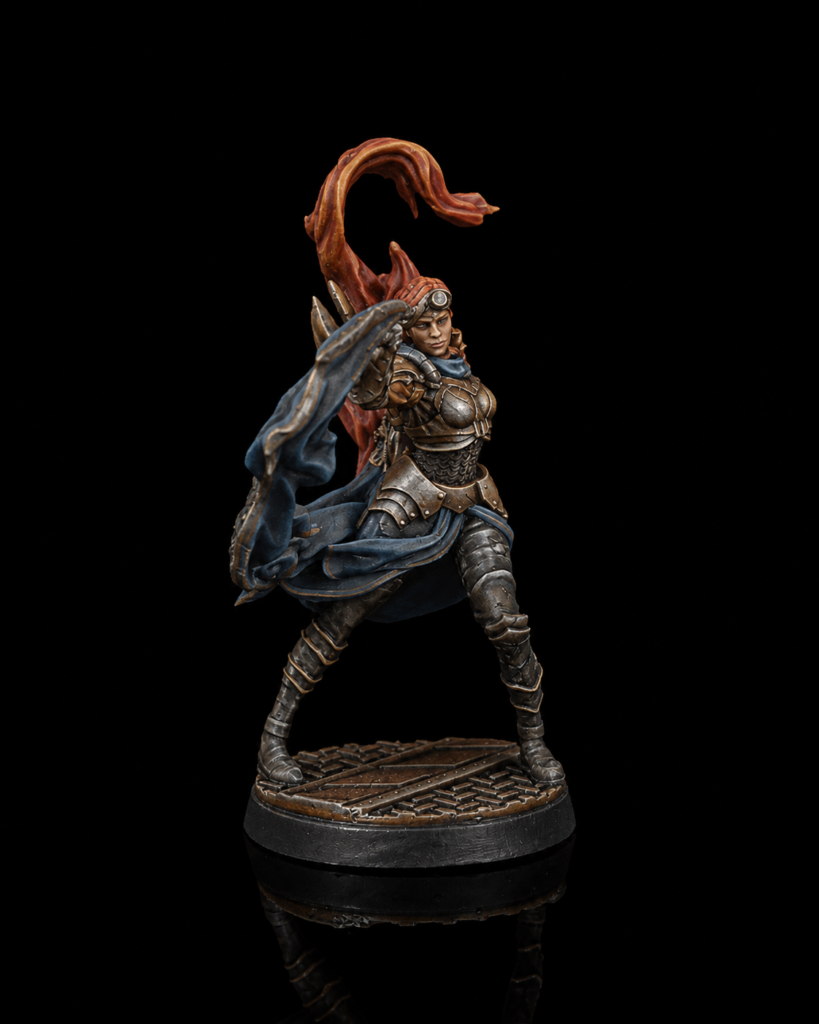
Together, they give you a way into Aurumdell that isn’t just “kill the villain’s robots.” There’s a real emotional throughline running underneath the industrial spectacle, if your group wants to use it.
Why We Built This in Resin
We keep coming back to this point because it genuinely matters for a collection like this one: the mechanical detail is the selling point, and resin is what makes that detail survive the printing process intact. Panel lines, rivet rows, joint housings, the layered plating on the Golden Strider Golem — none of that reads properly at 32mm scale without the resolution resin gives you. FDM has its place in our catalogue, but Aurumdell was always a resin collection from the first concept sketch.
Every piece in the range is printed to order, supplied unpainted and ready for your palette, and built at 32mm scale for standard tabletop use, with the Carcinowalker and Steam Rhinodrome sized up on larger creature bases to match their role on the table.
What’s Next for Aurumdell
This deep-dive is really just the front door. We’ve got character spotlights and painting guides planned for individual pieces in the collection — starting with the drone trio and working through toward the Carcinowalker as a dedicated centrepiece painting tutorial. If there’s a specific model or a specific technique you want covered first, that’s exactly the kind of thing worth flagging to us directly.
For now, if this is your first look at the collection, the full Ironworks of Aurumdell range is the best place to see how all of these pieces sit together on the table.
Where myths take form.
Continue Your Journey
- Browse the full Ironworks of Aurumdell collection — see every piece from the drone trio to the Carcinowalker in one place
- What is resin printing — and why does it matter for miniatures? — the case for resin, explained for buyers weighing FDM against resin detail (post pending — Month 1 content calendar)
- Save with the complete Ironworks of Aurumdell collection bundle — all eleven pieces, one connected narrative
Leave a Reply